
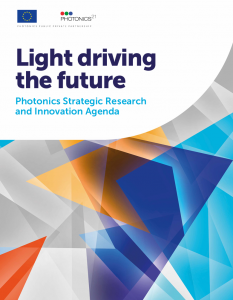
Photonics21 presented the latest European Photonics Roadmap, the Strategic Research and Innovation Agenda (SRIA) Light Driving the Future, to the European commission at the Photonics21 annual meeting on the 9 June 2026. Light Driving the Future is the sector’s most significant strategic update since Horizon Europe began and set out a vision for teh next . The handover brought together senior figures from industry, research and government to discuss Europe’s long‑term technological resilience, competitiveness and sovereignty.
Discussions focused on the growing role of photonics in addressing Europe’s most pressing challenges, including the energy demands of artificial intelligence, dependence on non-European semiconductor supply chains, secure communications, advanced manufacturing, and the scaling of quantum technologies.
Lutz Aschke, President of Photonics21 and a Supervisory Board Member at Light Conversion, said: “While Europe prepares its next long-term research and innovation programme, this year’s Photonics Partnership Annual Meeting is an important opportunity to reflect on where Europe leads, where it must invest, and how it can remain competitive in an increasingly technology-driven world. “Photonics already powers much of the modern world, from global communications and advanced manufacturing to healthcare, energy and emerging quantum technologies. As the new Strategic Research and Innovation Agenda sets out, the window of opportunity is open, but it will not remain so indefinitely. Europe has a chance to lead the world in photonics through targeted investment, mission-driven innovation and a coordinated approach to the challenges and opportunities ahead.”
Grand Challenges
Central to the new strategy is a series of Photonics “Grand Challenges” – mission-driven priorities designed to help Europe maintain leadership in artificial intelligence, semiconductors and other next-generation technologies, including energy‑efficient AI infrastructure, photonic chip manufacturing, secure optical communications, and scalable quantum networks.
The explosive growth of AI systems is driving strong demand for technologies in which photonics plays an increasingly important role, including fast data transfer, powerful processing chips and lower-energy computing infrastructure.
Against a backdrop of intensifying global competition for semiconductors, AI infrastructure and industrial sovereignty, the meeting focused on Europe’s technological resilience, competitiveness and long-term strategic capability.
Although often invisible to the public, photonics has become a key enabling technology for modern economies. It underpins everything from AI datacentres and smartphone sensors to satellite communications, lasers, advanced healthcare imaging and emerging quantum technologies.